
Where your data goes Who handles it, and why.
Merto runs on other companies' services. This is each kind of company, what reaches it, and what it does with it.
Hosting
- What reaches them
- Every request to this site and the app, and a live call while it is on.
- What they do with it
- Runs this site, the app and our servers.
- Where
- The servers for this site and the app run in Canada. The voice service that handles live calls runs in the United States.
Database
- What reaches them
- Our records: customers, conversations, deals, visits and consent, and stored files such as photos and voicemail audio.
- What they do with it
- Holds our records and stored files, such as photos and voicemail audio.
Phone and text carrier
- What reaches them
- Texts, calls and voicemail on a salesperson's line, and the sign-in codes we text.
- What they do with it
- Carries texts, calls and voicemail, and sends sign-in codes.
Speech
- What reaches them
- The audio of a live call, a voice note or a voicemail.
- What they do with it
- Connects a call to the assistant, turns speech into text on calls, voice notes and voicemail, and speaks the assistant's voice.
AI models
- What reaches them
- The words of a conversation, photos, and the facts of a deal needed to write or check a reply.
- What they do with it
- Read and write the assistant's words, read photos, and check what the assistant says.
Search
- What reaches them
- The store's own documents, and the words of a search.
- What they do with it
- Searches the store's own documents, and the web when a salesperson asks.
Email
- What reaches them
- Email to and from a salesperson's Merto address: the addresses and the words.
- What they do with it
- Sends and receives email.
Payments
- What reaches them
- The store's billing details. A card is entered on the payment provider's own page.
- What they do with it
- Takes the store's payments.
Scheduling
- What reaches them
- What a visitor types into the calendar on the booking page, such as a name and email, and the time picked. The calendar's own page asks about its own cookies, and you can decline them there.
- What they do with it
- Runs the calendar on the booking page and holds the bookings made there.
Analytics
- What reaches them
- Visits to this site's pages, counted. Nothing from inside the app.
- What they do with it
- Counts visits to this site.
Code workspace
- What reaches them
- The figures and files a salesperson gives Merto to work out a sum or make a file.
- What they do with it
- A closed workspace where Merto works out a sum exactly, such as a payment, or makes a file a salesperson asked for, such as a spreadsheet.
Some of the providers above process data in the United States or elsewhere outside Canada. Live calls are handled by our voice service, which runs in the United States.


What we keep, and for how long These are the numbers the product's own clean-up runs on.
A customer's conversations, notes and deal details
24 months
After the last activity on their record, such as their last message or a change to their deal.
A closed store's remaining data
30 days
After the store closes, except the records billing must keep, each request to stop, and the one-way codes below.
Proof of how a customer agreed to hear from a salesperson
3 years
After the last message to them, even after an erasure, because the law puts that proof on the sender. If the store closes first, it goes 30 days after the close with the store's other records.
A customer's request to stop
No end date
Kept so the stop stays in force: the number or address it applies to, and when.
A one-way code for someone who asked to be erased
No end date
Kept so a later import of a customer list does not add them again. It cannot be turned back into the number or email.

What an erasure removes And the three things it keeps, on purpose.
A person can ask us to erase their information. They can write to us or tell the salesperson, and a person on our team carries it out. The assistant itself cannot erase anything.
An erasure deletes their conversations, notes, deal details, files and contact details, and the copies Merto put in a salesperson's connected calendar. It also deletes the phone company's copies of their texts and calls where the phone company allows it. A booked visit keeps its time and status, without their name.
Some copies stay with our providers, because those providers offer no way to delete them: an email already sent stays with our email provider, and the call service keeps a log of each call that holds the caller's number. A text the phone company was still sending, and a voicemail it refused to delete, also stay with it.
It keeps three things, on purpose:
A request to stop, with the phone number or email it applies to, so the stop stays honoured.
The proof of how they agreed to hear from the salesperson (who, when and how), for 3 years after the last message to them, as the law requires.
When they asked for the erasure themselves, a one-way code made from each of their phone numbers and emails. It cannot be turned back into the number or email. It exists so that a later import of a customer list does not add them again.

What Merto will not do We would sooner tell you its limits than show you proof we do not have yet.
It never poses as the rep.
Its first words to a customer say it is the rep's assistant, and anyone who asks is told it is an AI assistant.
It never quotes a price it was not given.
A figure it gives a customer comes from the store's records, the deal's record or the customer's own words.
It never ranks reps against each other.
No manager's screen shows a count or a score beside a salesperson's name.
It never keeps writing to someone who said stop.
One fixed line confirms the stop, and nothing else goes to that customer on that channel.
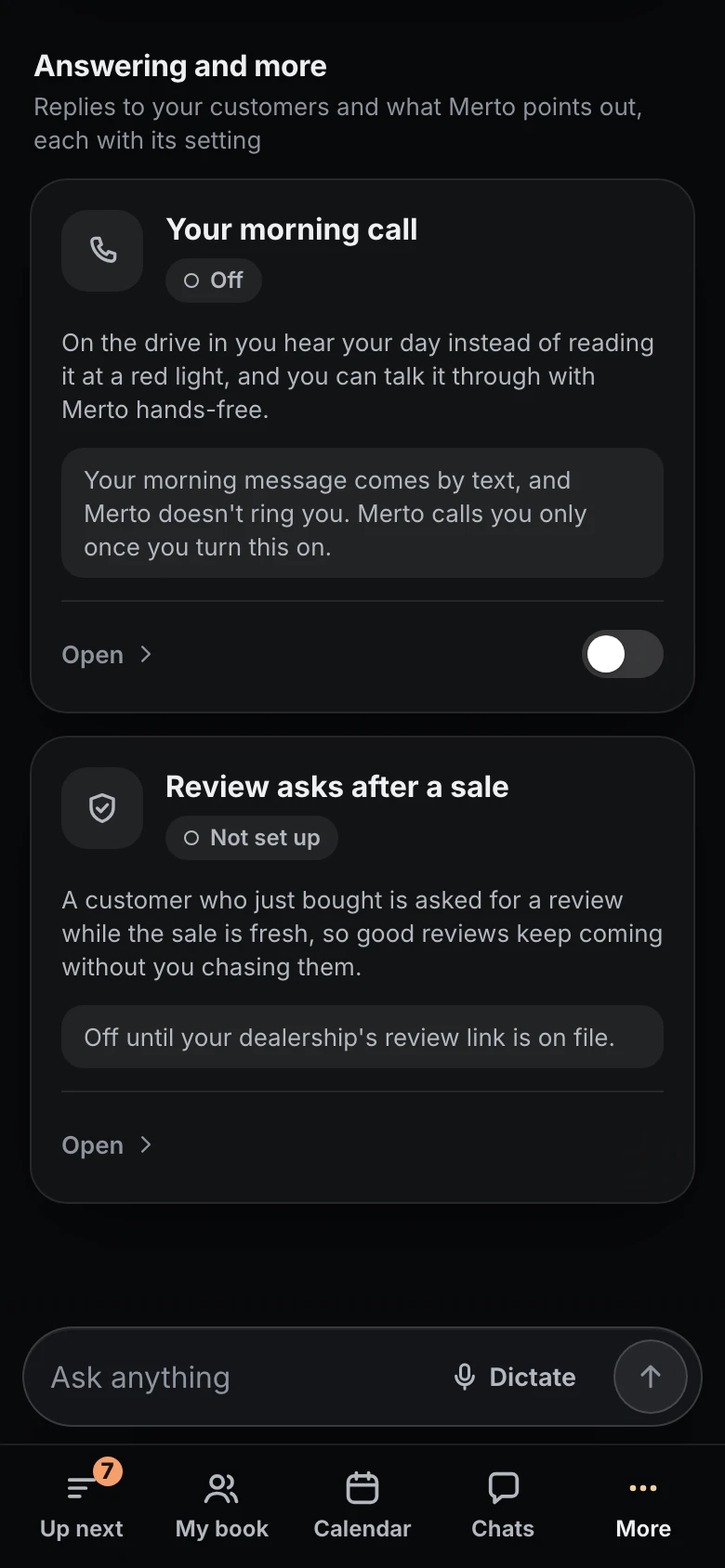
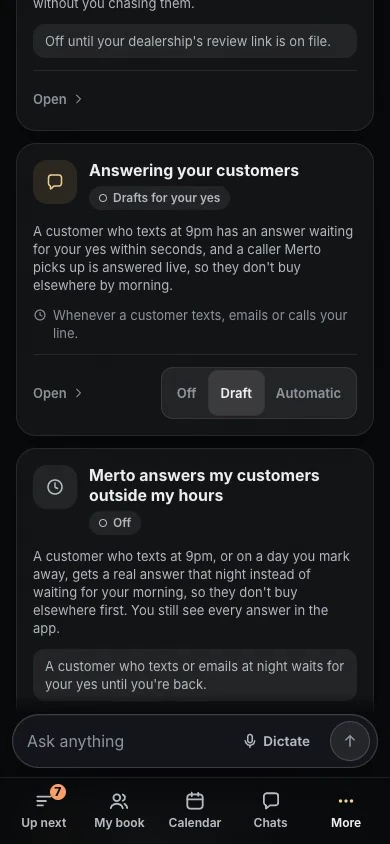
Drafted for your yes, or automatic if you choose.
Shown with a made-up store and made-up customers.

How your data is protected What is in place today, and the one thing that is not yet.
A rep signs in with a one-time code sent to their own cell, or with a passkey. A manager signs in with a code sent by email.
A manager sees each deal's stage and next step. A rep's conversation is shown to a manager only when the rep shares it.
One rep's customers are never shared with another rep's assistant, unless the customer is handed over.
Whether a message reaches a customer is decided by code, in one place for every channel. The assistant writes the words and cannot send past that check.
We do not record a live call. What was said is kept as text on the deal's record. A voicemail a caller chooses to leave is kept as audio.
A Social Insurance Number is kept only when it is given for a deal: by the rep, by the customer, or on a list the store imports. It is locked with a key kept apart from our database and shown only by its last three digits.
Where an AI company lets us choose that our requests are not stored or not used to train its models, our code makes that choice.
We do not hold a SOC 2 report yet. We will start a Type II when a dealer group or a US store asks for one.

Reach a person Write to us and a person answers.
Ask for the named list of companies, or send us your own security questionnaire.
Toronto, Ontario, Canada